
Insurance and risk
Experience helping families consider protection and financial responsibilities.

For investors approaching retirement
The operator matters as much as the property. Explore a real estate approach shaped by Robert Jugan's insurance background, rental ownership, and documented systems.
Start with education. No investment commitment.
Real estate investing involves risk, including loss of capital.
The experience behind the approach
Robert's background spans insurance, personally owned rentals, and written business systems. Each brings a practical perspective to the work, risks, and responsibilities behind a real estate plan.
Operating background
Experience helping families consider protection and financial responsibilities.

Direct experience with tenants, paperwork, and different housing uses.

Purchase processes and documented duties that clarify accountability.
Relevant experience should always be explained with a clear scope.
Beyond the projection
Before depending on projected income, understand the work, the risks, and who remains responsible when circumstances change.

Ask who handles the property, follows the operating plan, and responds when problems need attention.

Review the effect of lower income, higher expenses, and a plan that takes longer than expected.

Understand what will be reported, who will explain it, and how you can ask questions.
Know who does the work before you depend on the income.
Our approach
Robert's approach centers on conservative assumptions, clear responsibilities, and written systems. These are the questions Freedom Partners brings to evaluating a multi-unit plan.
Examine the income, expenses, financing, and housing demand the plan depends on. Ask what changes if the outlook becomes less favorable.
Understand the proposed reserves, the needs they address, and the limits of that preparation. Reserves do not remove investment risk.
Clarify who handles operations, monitors the plan, and responds when a decision or correction is needed.
Set expectations for milestone conversations and useful reporting. Investors should know how to stay informed and raise questions.
A plan becomes easier to evaluate when responsibility is visible.
Housing strategy
Robert's rental experience spans long-term stays, short-term stays, and shared housing. Freedom Partners is exploring how those operating lessons can inform larger multi-unit properties, where the property, resident demand, and operating requirements support the approach.

Illustrative housing
A focus on useful, well-maintained homes and consistent property standards for residents seeking an ongoing place to live.

Illustrative housing
An emphasis on comfort, preparation, turnover, and clear responsibilities for the details that shape a guest's stay.

Illustrative housing
An approach that considers efficient use of space, resident needs, and the operating requirements of people sharing a property.
The intended use should make sense for the people living there. Housing strategy depends on the specific property and its operating requirements.
Meet Robert Jugan

For more than 41 years, Robert worked as an insurance agency owner and agent, helping families think through protection, property, and financial responsibilities.
Alongside that career, he built experience through more than 22 years of personally owned rental real estate. His work included interviewing tenants, handling paperwork, and operating long-term rentals, short-term rentals, and shared housing.
His short-term rental experience spans 10 years, and his shared housing experience spans 6 years. These are parts of his operating background, not additional years to add to his rental history.
In his agency, duties were documented. When he bought rentals, he followed a written purchase system. That attention to responsibility now shapes the platform he is building through Freedom Partners.
“The system is the solution.” Robert Jugan, Founder
Insurance experience and personal rental ownership are distinct from multi-unit fundraising experience.
Where we stand
Freedom Partners is preparing its first capital raise for multi-unit properties. Robert brings experience in insurance and personally owned rentals; this platform is at the beginning of its multi-unit fundraising history.
That distinction belongs in the conversation. Ask about the team, the specific plan, the risks, and the documents behind any opportunity you consider.
Your questions should start with an accurate picture of the experience.
An education call does not establish the availability or suitability of an investment.
Who this conversation is for
You may be exploring real estate income potential as retirement approaches, while wanting to step away from day-to-day property management. The conversation starts with understanding your questions and the responsibilities behind the investment approach.
Staying informed is part of investing passively.
Any future investment has its own risks, eligibility requirements, and liquidity constraints.
Free investor guide
Passive Real Estate With Purpose
Use the guide as a starting point for your own review of the operator, the housing strategy, and the risks—then bring your questions to a conversation with Robert.
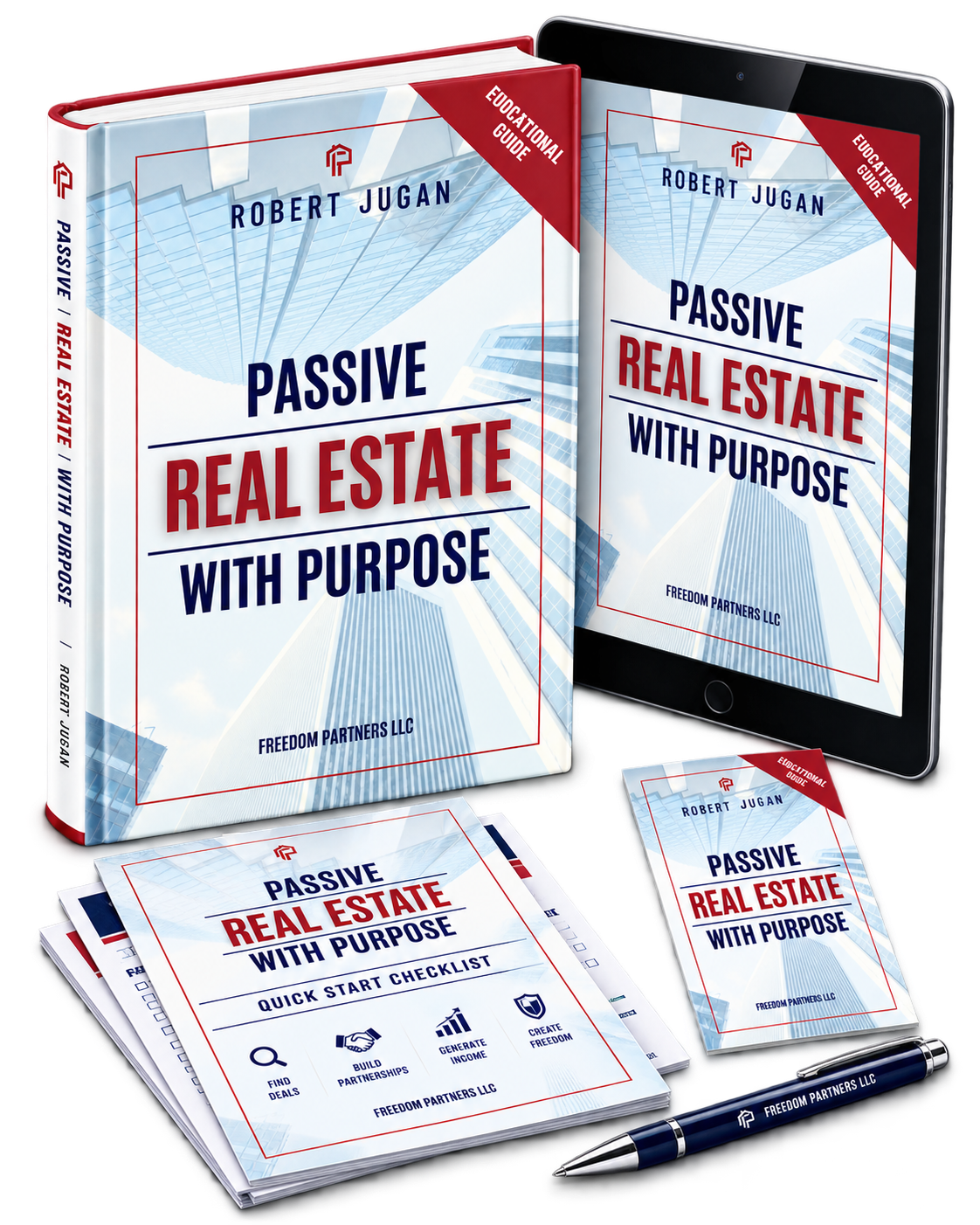
Educational material. Completing the form does not create an investment commitment.
Investor questions
Understand the experience, the approach, and the limits before discussing a specific investment.
This is Robert's first multi-unit capital raise. His background includes an insurance career and personally owned rental properties, with experience in long-term rentals, short-term rentals, and shared housing. Those experiences inform his approach, but they should be evaluated separately from a multi-unit fundraising track record.
The strategy draws on Robert's experience with long-term rentals, short-term rentals, and shared housing. Freedom Partners is exploring how those lessons may apply to larger multi-unit properties. The appropriate use depends on the property, resident demand, and operating requirements.
No. Robert's insurance background informs how he thinks about risk; it does not insure investor capital or guarantee income. Real estate investments can lose value, and private investments may be illiquid and involve loss of the entire investment.
Those details depend on the specific offering and its final documents. Before deciding, review the economics, fees, investor rights, risks, and any restrictions with your own advisors. This page does not publish standing investment terms or promise a return.
Robert's stated approach emphasizes transparent conversations and scheduled milestone updates. For a specific opportunity, ask who provides reporting, what it includes, how often it arrives, and how questions are handled.
The conversation starts with your goals and questions, followed by Robert's background, housing strategy, and approach to operations and risk. The call is educational, creates no obligation to invest, and does not replace advice from your own qualified professionals.
Begin with a conversation
Talk with Robert about your goals, his operating background, and the questions worth asking about passive real estate. Start with a clearer understanding of the approach and what still needs to be evaluated.
A conversation first. No investment commitment.